What Bowling Green’s Bronze Recognition Can Teach Other Communities
What Bowling Green’s Bronze Recognition Can Teach Other Communities
How local coordination, persistence, and practical planning helped move Bowling Green forward
In Bowling Green, progress toward a more bike-friendly community did not happen all at once. It grew through planning, partnership, public input, and a steady commitment to making bicycling a safer and more visible part of community life.
That work reached an important milestone when Bowling Green, Kentucky, earned Bronze-level Bicycle Friendly Community recognition through the League of American Bicyclists’ 2025 Bicycle Friendly Community submission round. The recognition placed Bowling Green among a small group of Kentucky communities currently recognized through the national program and marked an important step forward for active transportation in southcentral Kentucky.
For Bike Walk Kentucky and active living partners across the state, Bowling Green’s recognition offers a practical example of what local progress can look like: not a single project, not a single event, and not a single organization working alone, but a coordinated effort that connects planning, education, encouragement, infrastructure, and community commitment.
A Community Moving Forward
The Bicycle Friendly Community program recognizes communities working to make bicycling safer, more accessible, and more welcoming for transportation, recreation, fitness, and everyday life.
Bowling Green’s Bronze recognition reflects years of local effort and demonstrates that bicycle-friendly communities are built through intentional planning, partnership, and persistence.
The 2025 recognition is especially meaningful because Bowling Green’s Bicycle Friendly Community history tells a story of persistence. The community previously applied and did not receive an award, later received Honorable Mention, and then moved forward to earn Bronze recognition. That progression matters because it shows that the Bicycle Friendly Community process can be more than an award application. It can serve as a roadmap for improvement.
For communities across Kentucky, that is an important lesson. A first application does not have to be the finish line. Feedback can become a work plan, local conversations can become action steps, and partnerships can become progress.
Partnership at the Center
Bowling Green’s Bicycle Friendly Community application was spearheaded by the Bowling Green-Warren County Metropolitan Planning Organization and BikeWalkBG, with representatives from city, county, state, and community organizations participating in the process.
That collaborative structure is one of the most important parts of the story.
Active living work is rarely owned by one department or one organization. Streets, sidewalks, trails, public health, tourism, schools, parks, planning, enforcement, and economic development all influence how people move through a community. Bowling Green’s progress reflects the value of bringing those voices together.
The MPO helped connect bicycle-friendly goals to transportation planning processes and long-term community priorities. BikeWalkBG helped bring community perspective and local advocacy into the conversation, while government agencies and organizational partners helped frame the work as more than recreation. Together, those partners demonstrated how bicycling connects to safety, health, access, community vitality, and quality of life.
Why Bronze Matters
Bronze recognition does not mean the work is complete. It means a community has demonstrated meaningful commitment and established a foundation to build from.
For Bowling Green, that foundation includes bike education efforts, regular events that encourage bicycling, supportive policies, and infrastructure investments. It also includes honest recognition of what still needs improvement.
That combination is what makes Bowling Green’s story useful for other Kentucky communities. The Bicycle Friendly Community process does not require a place to be perfect. It asks communities to assess where they are, identify gaps, document progress, and continue improving.
In Bowling Green’s report card, local feedback pointed to clear community priorities, including the desire for more bike paths, more bike lanes, and increased education for drivers. Those responses are not setbacks. They are direction. They tell local leaders where people see opportunity and where future investments may have the greatest impact.
Active Living in Practice
Bowling Green’s progress also demonstrates why active living is not simply a public health concept. It is a community design issue.
When people have safer, more comfortable ways to bike or walk to parks, schools, downtown destinations, workplaces, and neighborhoods, physical activity becomes easier to incorporate into daily life.
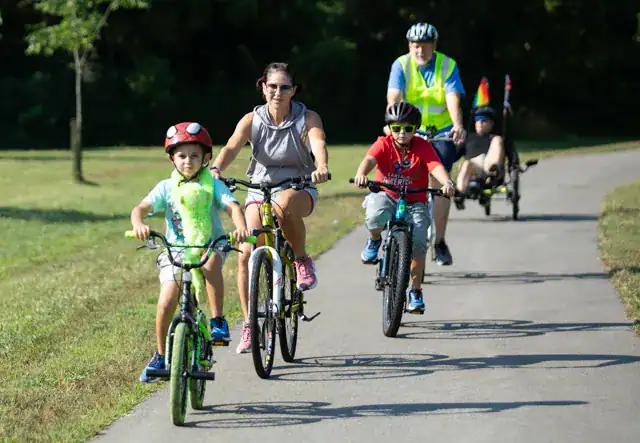
A bike-friendly community supports more than people who already ride. It supports children learning safe habits, families seeking accessible recreation, students traveling to school, workers looking for transportation options, and residents who want to experience their community at a slower, more connected pace.
This is the connection Bike Walk Kentucky continues to emphasize statewide: active living depends on both behavior and environment. Encouragement matters, but so do safe crossings, connected routes, maintained networks, and community planning that considers people of all ages and abilities.
Lessons for Other Kentucky Communities
Bowling Green’s recognition offers several lessons for communities across Kentucky.
First, progress can begin with assessment. The Bicycle Friendly Community application process helps communities look honestly at what exists, what is missing, and where local energy can be directed.
Second, partnerships matter. The involvement of the MPO, BikeWalkBG, government representatives, and community organizations shows that active transportation work becomes stronger when planning, advocacy, public health, tourism, and local leadership are connected.
Third, feedback is valuable. Community input about bike paths, bike lanes, driver education, and perceived safety provides a practical starting point for future action.
Finally, recognition can build momentum. A Bronze award gives Bowling Green something to celebrate, but it also provides a platform for the next phase of improvement.
Looking Ahead
Bowling Green’s Bicycle Friendly Community recognition is not the end of the story. It is a milestone.
The work ahead will include continued planning, investment, education, evaluation, and public engagement. However, Bowling Green has already demonstrated something important: Kentucky communities can make measurable progress when local partners organize around shared goals and use available tools to guide their work.
For Bike Walk Kentucky, Bowling Green’s story reinforces the value of statewide support, local leadership, and practical active living resources. It shows how a community can move from assessment to action, from feedback to improvement, and from aspiration to recognition.
Most importantly, it shows that safer, healthier, and more connected communities are possible in Kentucky. Progress begins locally, and Bowling Green is proof.