Independence Should Not End at the Curb
Independence Should Not End at the Curb
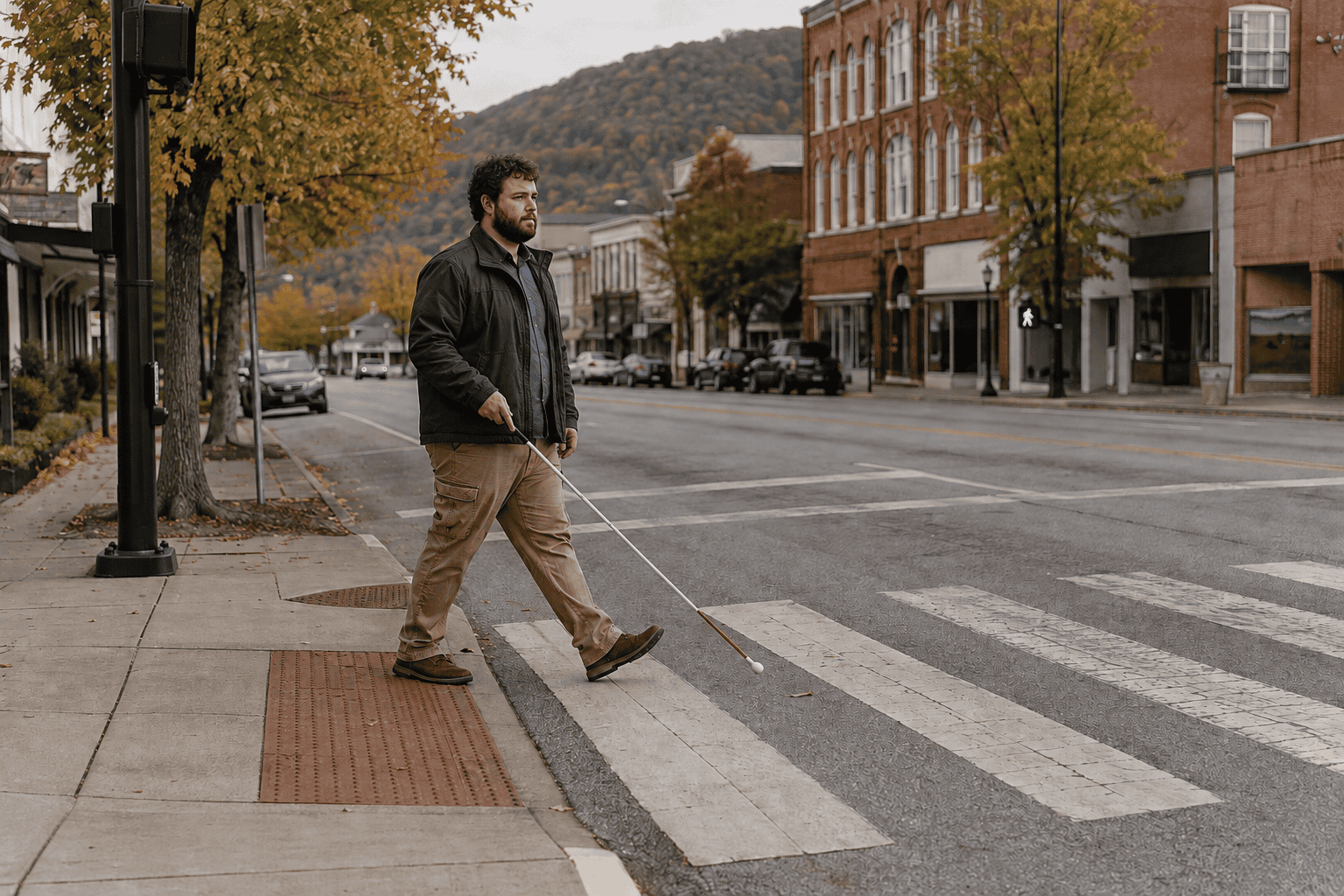
Walk outside in a busy part of your town and stop for a moment. Listen before you look. Hear the engines moving through the intersection, a truck accelerating after the light changes, footsteps passing behind you, a conversation spilling out of a storefront and the warning beep of a vehicle backing somewhere nearby. Notice how quickly one sound overlaps another and how difficult it can be to tell which noise is close, which is moving and which requires your attention.
Now close your eyes, if you can do so from a safe place. The familiar intersection changes. You may listen for the surge of parallel traffic to understand when the light has changed. You may try to separate the sound of a turning vehicle from one continuing straight. You may search for the edge of the sidewalk with your feet and wonder whether the curb ramp points into the crosswalk or toward the middle of the intersection. Then open your eyes again.
That brief exercise does not recreate blindness, and it cannot teach a sighted person what it is like to navigate the world as someone who is blind or has low vision. Blind people develop orientation and mobility skills, use white canes or guide dogs, learn routes, interpret sound and texture, and travel independently every day. But the moment can reveal something important: how much information our streets communicate visually, how much uncertainty poor design creates, and how quickly independence can be restricted when the environment does not provide reliable cues.
A white cane is not a symbol of helplessness
The white cane is a tool of independence. It helps a person detect changes in surface, locate edges and obstacles, follow a path and gather information about the space ahead. It also communicates to drivers and other people that the traveler is blind or has low vision. White Cane Awareness Day, observed October 15, is an opportunity to recognize that independence and to consider whether our communities support it.
Kentucky law is clear: drivers must yield the right-of-way to a blind pedestrian carrying a clearly visible white cane or accompanied by an assistance dog. That legal protection matters. Yet the ability to travel safely cannot depend on every driver noticing, understanding and responding correctly at the exact moment a person enters the street.
A law can establish the right to cross. The built environment determines how safely and confidently that right can be used.
When the route is unreliable, freedom gets smaller
Consider what happens when a sidewalk simply ends, when construction sends pedestrians into an unmarked detour, or when a utility pole narrows the path until it is impassable. Think about a crosswalk with no audible pedestrian signal, a curb ramp that aims diagonally into moving traffic, or a push button positioned where it cannot be found or reached easily. Each failure adds uncertainty. Together, they can make a routine trip exhausting, dangerous or impossible without assistance.
The consequence is not merely inconvenience. It can mean depending on someone else to get to work, a medical appointment, the grocery store, a place of worship or a community meeting. It can mean paying for transportation when walking or transit should have been an option. It can mean declining an invitation because the route is unfamiliar and the crossing conditions are unpredictable. Over time, an inaccessible transportation system can quietly narrow a person’s choices, participation and control over daily life.
That is why pedestrian accessibility is fundamentally about independence. Safe mobility allows people to decide where to go, when to leave and how to participate in their communities. When a town makes those ordinary decisions contingent on sight or on the availability of another person, it has placed a limit on freedom that many residents never have to consider.
Design should communicate clearly
Accessible streets provide consistent, usable information. Continuous sidewalks create a dependable path. Detectable warning surfaces identify the transition from sidewalk to street. Curb ramps aligned with the crossing help establish direction. Accessible pedestrian signals communicate when the walk phase begins. Adequate crossing time, slower turning speeds and daylighted intersections reduce the number of threats a person must interpret at once. Transit stops remain connected to the pedestrian network rather than isolated beside a road.
Maintenance matters just as much as installation. Snow, leaves, broken pavement, overgrown vegetation, temporary signs and parked vehicles can erase an accessible route even when the original design was sound. Construction plans should preserve a detectable, navigable pedestrian path instead of treating access as an issue to resolve after the work is underway.
Build with people, not merely for them
Communities should not assume what blind residents need. They should include people who are blind or have low vision in walk audits, project planning, transit conversations and accessibility reviews from the beginning. Lived experience can identify problems that a checklist misses: a signal that is technically present but difficult to locate, a crossing where turning traffic masks the audible cue, or a route that changes character without warning.
On White Cane Awareness Day, notice the cane, but do not stop at awareness. Notice the street around it. Ask whether the sidewalk continues, whether the crossing communicates clearly and whether a person can move through that place without surrendering independence. A community is not truly walkable if safe navigation depends on sight. Independence should not end at the curb, and the responsibility belongs to all of us.