
A Few Miles Per Hour Can Mean the Difference Between Life and Death
A Few Miles Per Hour Can Mean the Difference Between Life and Death
Why safer speeds are essential to creating communities where people can walk, bike and move with confidence
A person walking across a street has little protection when struck by a vehicle. As speed increases, so does the force of impact, sharply raising the likelihood of severe injury or death. Understanding that relationship is essential to any serious conversation about safer streets, active living and community design.
The risk rises faster than many people realize
Research from the AAA Foundation for Traffic Safety estimates that the average pedestrian’s risk of death reaches approximately 10% at an impact speed of 23 mph. That risk increases to 25% at 32 mph, 50% at 42 mph, 75% at 50 mph and 90% at 58 mph. The risk of severe injury begins rising at even lower speeds, reaching approximately 50% at an impact speed of 31 mph.
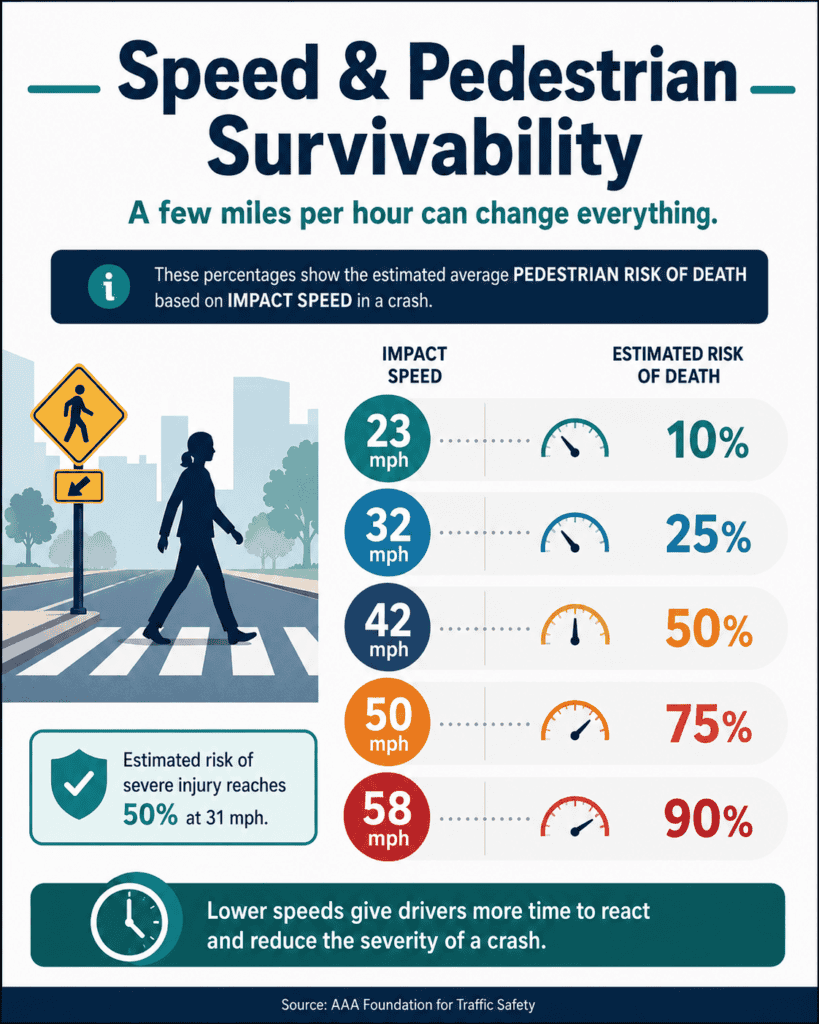
These figures describe impact speed, which is the vehicle’s speed at the moment it strikes a person. Impact speed is not necessarily the same as the posted speed limit or even the speed at which the driver was traveling before recognizing the danger and applying the brakes.
Road conditions, driver reaction time, visibility, braking distance and the location of the pedestrian all influence the eventual impact. Even so, the overall lesson is clear: a relatively small difference in speed can produce a dramatically different outcome.
Federal Highway Administration research explains that higher speeds increase the energy involved in a crash, and that energy rises in relation to the square of the vehicle’s speed. A vehicle traveling twice as fast does not create only twice the crash energy. The increase is much greater, which is one reason injury severity escalates so quickly.
Lower speeds give drivers more time to respond
Speed affects more than the force of a collision. It also affects whether a collision happens at all.
A driver traveling at a lower speed has more time to notice a person crossing the street, understand what is happening and respond. The vehicle also travels a shorter distance during that reaction and requires less distance to stop after the brakes are applied.
At higher speeds, the driver covers more ground before reacting, needs more room to stop and has less opportunity to correct a mistake. A child stepping unexpectedly from behind a parked vehicle, an older adult who needs more time to cross or a person using a wheelchair may leave a driver only a few seconds to respond.
Drivers are not the only people who make mistakes. A pedestrian may misjudge a vehicle’s speed, become distracted or cross where visibility is poor. The U.S. Department of Transportation’s Safe System approach recognizes that people will make mistakes and that the transportation system should be designed so those mistakes are less likely to result in death or serious injury.
The posted speed limit is only part of the street
Safer streets require responsible driving, but signs alone do not determine how fast people travel. The physical design of a roadway sends powerful signals about what speed feels appropriate.
Wide lanes, long uninterrupted stretches of pavement and large turning areas can encourage drivers to travel faster, even when the posted speed limit is relatively low. A street may say 25 mph on a sign while its design communicates that 35 or 40 mph feels comfortable.
Streets designed around people as well as vehicles can communicate something different. Shorter pedestrian crossings, narrower travel lanes, visible crosswalks, curb extensions, raised crossings, pedestrian islands, lighting improvements and other traffic-calming measures can encourage lower speeds and make people walking or rolling easier to see.
The goal is not to make every street identical or force vehicles to travel slowly on every type of road. A rural highway serving long-distance travel has a different function from a downtown street, residential neighborhood or route beside a school. Safe speed decisions should reflect who uses the roadway, what destinations surround it and how likely vehicles are to encounter people outside cars.
Safer speeds support active living
Speed management is also a public health issue. People are less likely to walk, bike or roll when they believe the route is dangerous, even when their destination is nearby.
A parent may decide it is not safe for a child to walk to school. An older adult may avoid crossing a busy road to reach a store or community center. A family may drive to a park that is only a few blocks away because the route does not feel comfortable on foot.
Those decisions may appear personal, but they are strongly influenced by the built environment. Active living becomes more realistic when communities provide routes that allow people to move safely as part of their everyday routines.
That can mean walking to school, bicycling to work, rolling to a neighborhood park or completing a short errand without relying on a vehicle. Safer speeds help make those choices possible because they reduce both the likelihood of a crash and the severity of the outcome when something goes wrong.
Some road users face greater consequences
A single speed does not create the same level of risk for every person. The AAA research found that age significantly affects a pedestrian’s likelihood of severe injury or death. Older adults are generally less physically resilient and may be more seriously harmed by the same impact than younger pedestrians.
Children may also be difficult for drivers to see because of their height, and they may behave less predictably near traffic. People with disabilities may move at different speeds, need more time to cross or face barriers that prevent them from quickly leaving a vehicle’s path.
Designing for the most vulnerable person creates a safer environment for everyone. A crossing that provides enough time for an older adult also benefits a parent with a stroller, a young child, an injured person using crutches and anyone carrying groceries or moving at a slower pace.
Safety should not depend on perfect behavior
Public safety campaigns often focus on individual responsibility, reminding drivers to pay attention and pedestrians to use marked crossings. Those messages have value, but education alone cannot remove every risk.
No driver will remain perfectly attentive during every mile traveled, and no pedestrian will make the ideal decision during every trip. Weather changes, sight lines become obstructed, vehicles turn unexpectedly and people misunderstand one another’s intentions.
A safer transportation system accounts for those realities. It combines appropriate speed limits with roadway design, education, visibility improvements and targeted enforcement so that one moment of inattention is less likely to become irreversible.
The U.S. Department of Transportation describes safer speeds as a combination of context-appropriate roadway design, suitable speed limits, education, outreach and enforcement. That shared approach moves the conversation beyond blaming one road user and toward creating conditions that protect everyone.
A few miles per hour matter
Speed can feel like a minor difference from behind the wheel. Traveling 30 mph instead of 25 mph may not seem especially significant to a driver trying to reach work, school or an appointment.
For the person crossing the street, however, those few miles per hour can affect whether the driver stops in time, how forcefully the vehicle strikes and whether the person survives.
Kentucky communities do not have to choose between mobility and safety. Roads can continue serving drivers while also recognizing the needs of people walking, biking, rolling, using transit or reaching destinations along the corridor.
The first step is understanding that speed is not only about how quickly traffic moves. It is about how much time people have to respond, how much force a human body must absorb and whether an ordinary mistake becomes a close call, a serious injury or a death.
When communities manage speed with those consequences in mind, they create more than safer roads. They create places where people of different ages, abilities and incomes have greater freedom to move through daily life.